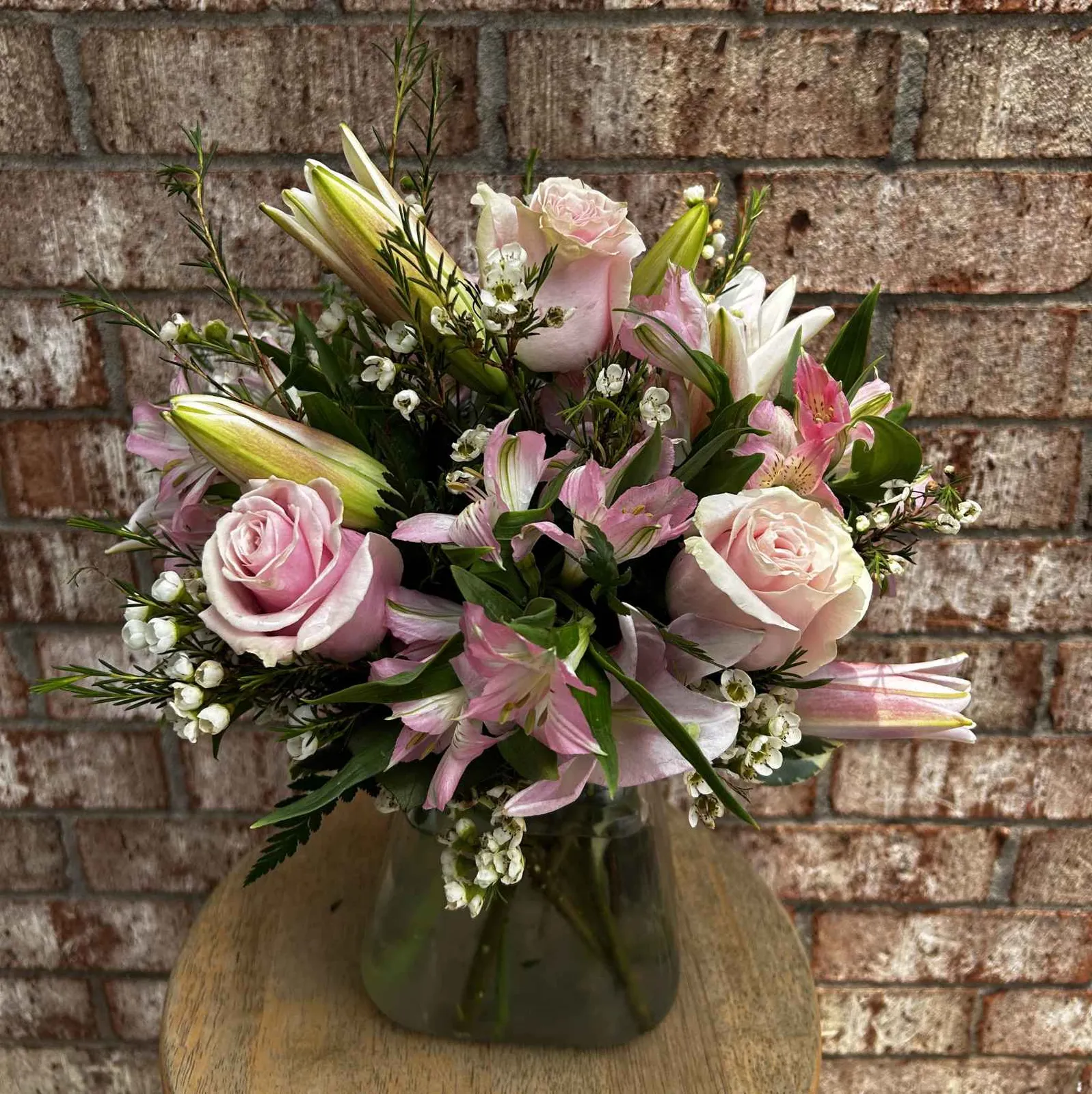
Context
University Flowers is a florist in the Bryan and College Station area of Texas, a short distance from the Texas A&M campus. It arranges and delivers flowers for everyday orders, gifts and seasonal occasions, and sells through an online storefront built on a floral industry commerce platform that carries orders beyond the immediate area. Its clientele was long established and local, built up over years of trade, and already included organizations that order as groups alongside individual buyers.
The same owner ran a second retail business in the same area, a shop dealing in jewelry, gold and coins. That store had no website and no online store, and reached customers through its storefront and word of mouth while local retail discovery was moving toward search results, map listings and social profiles. By the fall of that year the owner was weighing both businesses at once: opening the florist to the campus population next door, and giving the second store a modern name, a modern look and a first website that could take orders and answer questions.
Challenge
University Flowers was an established florist near Texas A&M with a loyal customer base and an online storefront that reached beyond College Station. The owner wanted to bring more students and student organizations into that base, and also ran a second retail business, a jewelry and gold shop, that had no website at all and needed a more modern identity. The questions put to TASK were practical rather than open ended: how to reach a campus audience using tools the florist already had or could get for free, how to give the second business an online store with live chat on a small budget, and what a name and logo change for that store would actually involve. A first round of ideas had to be set aside because the owner had already acted on them, so the work had to find ground the businesses had not already covered.
How the team worked
The team's first round of ideas included managing the florist's finances more efficiently and expanding its online presence beyond College Station. The owner had already done both, so the team went back and looked for ideas the businesses had not yet tried, then narrowed the list to recommendations that fit the owner's stated needs and could be acted on quickly. The engagement settled into three workstreams: campus marketing for the florist, a website decision for the second business, and a rebrand for that same store.
For the campus outreach work, the team started from where a campus audience would actually come from, separating group orders placed by student organizations from individual orders tied to seasonal occasions, then matched each to a channel already open to a local business: the university's targeted mailing list and printed handouts at campus events. The email draft and flyer were built in free, accessible design tools so the business could edit and reuse them, and the team documented the flyer's anatomy rather than handing over a single finished file.
For the website, the team worked from the owner's three stated requirements, e-commerce, live chat and affordability, and compiled the plans, strengths and drawbacks of each builder from published reviews and the providers' own published plans. Each option was written up with its case for and against before a single recommendation was made, so the reasoning stayed visible, and the recommendation was paired with a mocked-up landing page showing what the store could look like on the chosen platform.
The rebrand work paired creative concepts with the practical side of a name change. The team set criteria first, that a name should be short and specific rather than generic and a mark should be readable and easy to recognize, then produced a shortlist of names with logo concepts for each. Alongside that ran a checklist of the offices, records and materials a name change touches, so the owner could see both what a new identity might look like and what it would take to make it official.
The implementation plan closed the engagement by turning each recommendation into a first move: who to email to apply for the mailing list, how to add email marketing to the platform the florist already used, how to begin a trial on the recommended website builder, and the trade-off between building the site in house and hiring a contractor to do it.
Workstreams
- Mapped where a campus audience could come from, including student organizations, individual orders, and seasonal occasions, and identified the university's targeted mailing list and on-campus flyers as the most practical ways to reach it.
- Drafted a marketing email and a campus flyer, with a breakdown of the details any future flyer should carry, from the business name in the header through contact details, hours, imagery and a plain statement of the services offered.
- Designed three modernized logo concepts for University Flowers that stayed true to the existing brand while appealing to a younger audience.
- Compared Wix, Squarespace, and Shopify against the second business's requirements for e-commerce, live chat, and affordability, recommended Squarespace, and mocked up a sample landing page.
- Developed name and logo concepts for the second business and outlined the legal and administrative steps of a name change, from trademark search and state filing to tax, banking, licenses, contracts, and marketing materials.
- Wrote an implementation plan covering email outreach through the florist's existing website platform and the university mailing list, the choice between building the website in house or hiring a contractor, and updating public listings and signage under the new brand.
What the team found
- The campus audience reached the florist through two separate doors: student organizations ordering on behalf of a group, and individual students ordering for seasonal occasions.
- The florist's existing website platform already carried marketing features beyond the storefront, so campus outreach could run on tools the business was paying for rather than new ones.
- No website builder reviewed led on every criterion: the most customizable one was the hardest to learn, and the strongest commerce one leaned most on paid add-ons for basic features.
- Live chat came as an optional plugin on all three platforms rather than a built-in feature, so that requirement alone did not separate the options.
- The builder that rated highest for template design and ease of use also supported content pages alongside a store, which suited a business publishing its first website rather than a large catalog.
- Short names anchored to a place or to the shop's own character read as more distinctive than longer, generic category names.
What the client received
- Final written deliverable with executive summary, three deliverable sections, and an implementation plan
- Final presentation deck covering goals, proposed solutions, and recommendations
- Website builder comparison deck weighing three platforms on plans, strengths, and drawbacks
- Drafted marketing email for the university's targeted mailing list
- Campus flyer plus a breakdown of the details any future flyer should carry
- Three modernized logo concepts for University Flowers
- Name shortlist and paired logo concepts for the owner's second business
- Legal and administrative checklist for a business name change
- Sample Squarespace landing page for the second business
- Implementation plan covering email outreach, website build options, and rebrand rollout
Outcome
University Flowers came away with a ready-to-send email, a flyer and a template for making more, and logo options for a modern refresh, along with a clear picture of which campus channels were open to it and what each one asks for. The owner's second business had a recommended website platform with a step-by-step way to start, a sample landing page to react to, a shortlist of names with logo concepts for each, and a checklist showing what making a name change official would involve and where a professional should be consulted.
Recommendations
- Reach the campus audience through the university's targeted mailing list, sending a marketing email that carries the services offered, contact details and links for anyone wanting more.
- Pair the email with a printed flyer for campus events and for the organizations the florist already supplies, and reuse the flyer breakdown to produce more in house.
- Consider a modernized logo for University Flowers that keeps the existing brand recognizable while reading as current to a younger audience.
- Build the second business's website on Squarespace, chosen over Wix and Shopify for template quality, ease of use, built-in search and commerce tools, and an affordable path to live chat.
- Treat the second business's name and logo as one decision, choosing from the shortlist first and then settling the mark, keeping both short, readable and easy to recognize.
- Work through the legal and administrative checklist before the new name goes public, and consult a legal and tax professional on the steps specific to the business's structure.
Next steps
- The client was handed a drafted marketing email and a campus flyer, plus a breakdown of what any future flyer should carry, so the business could produce its own.
- The client was handed two routes for email outreach, one through the florist's existing website platform and its record of past orders, and one through the university mailing list.
- The client was handed a step-by-step start on the recommended website builder, from template selection through the free trial, with the build-in-house or hire-a-contractor choice laid out.
- The client was handed a sample landing page, name and logo concepts for the second business, and a legal checklist sequenced from trademark search and state filing through to signage.
The team
- Syarief Shahab, project lead
- Dylan Chin
- Ethan Niedzwiedz
- Hadi Tameez
- Julian Harrison
- Naysa Alex